WordPress or Astro for a small business site?
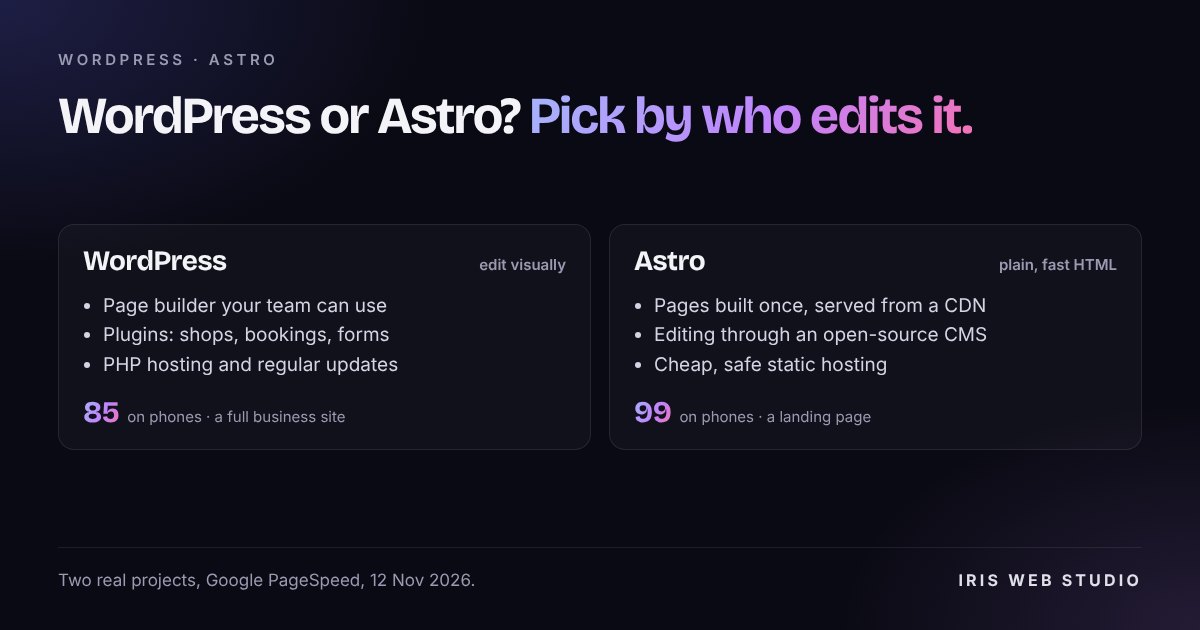
I build sites in both, so I am often asked which one is better. Neither. They solve different problems, and the right choice depends less on technology than on who will edit the site and what it has to do.
The short answer
How they differ
- Pages are put together on the server for each visit, with caching to speed that up.
- Editing in a visual page builder such as Elementor Pro.
- Thousands of plugins: shops (WooCommerce), bookings, forms, memberships.
- Needs PHP hosting and regular updates of WordPress, the theme and the plugins.
- Any WordPress developer can take it over.
Most flexible for the people editing it.
- Pages are built once into plain HTML and served from a CDN.
- Editing through an open-source CMS such as Strapi, Payload or TinaCMS.
- Features come from code and services rather than plugins.
- Static hosting is cheap or free, and there is no database or admin panel to break into.
- New features need a developer.
Fastest and lightest for the people visiting it.
A real comparison
Two of my own projects, measured with Google PageSpeed on the same day, 12 November 2026:
It is not a fair race: a whole business site against a landing page. But the shape of it is typical. On WordPress, a score in the 80s or 90s on phones is the result of tuning: caching, image work, fewer scripts. On a static Astro page, scores in the high 90s are common from the first build.
Choose WordPress when
- Several people edit the site every week and want to see the page as they change it.
- You sell online or take bookings: WooCommerce and booking plugins are mature and well known.
- You want any developer to be able to help, now or in five years. WordPress runs a large share of the web, and its developers are everywhere.
Choose Astro when
- Speed is part of the business: ads that pay per click, visitors on phones, a market where Core Web Vitals decide who ranks.
- The site is mostly content that changes now and then: a service business, a portfolio, a landing page, docs.
- You want low running costs and less to maintain: no plugin updates, no PHP hosting, no admin panel to protect.
Astro also has solid backing now. In January 2026 Cloudflare took on the team behind it, and Astro stays open source.
You can switch later
The choice is not forever. A WordPress site can move to Astro when speed starts to matter more than plugins: the content, the addresses and the SEO come along, with redirects for anything that moves. I do that as a fixed-price migration, from $450 and usually in 1–3 weeks. And if you stay on WordPress but the site is slow, speed optimization starts at $250.
Sources: the two PageSpeed results are from Google PageSpeed Insights on 12 November 2026 (mobile). The Cloudflare news: The New Stack, 16 January 2026.